St. George Island Plantation vs. East End: Which Cottage Nets More Rental Income
November 11, 2026 by Melissa Chandler
How do I evaluate whether a beachfront cottage in the St. George Island Plantation versus the east end of St. George Island will generate stronger net rental income after HOA fees and insurance in 2026?
You evaluate it by working backward from net income, not forward from purchase price. The Plantation’s higher nightly rates get eaten by HOA fees and elevated insurance, while the East End’s lower entry cost and zero HOA often deliver a stronger net return per dollar invested in 2026.
Why This Matters on St. George Island Right Now
The math on vacation rental investing has changed. As of mid-2026, per Foreclosure.com, the median home value on St. George Island sits at approximately $1,034,105, with values showing a -2.76% year-over-year decline. Meanwhile, insurance costs on barrier island properties continue climbing, and the Plantation’s HOA adds a fixed annual expense that the East End simply does not carry.
Here is what makes this question urgent: with roughly 69.5% of St. George Island’s housing units classified as vacant (per U.S. News & World Report data), the overwhelming majority of the island’s housing stock is tied up in vacation rentals and second homes. That means your competition as a rental owner is significant. In a market where homes are selling at approximately 94.5% of list price on average (per Be Major Team’s mid-year review), you have negotiating leverage on the acquisition side. But the purchase price only sets the stage. Your net rental income hinges on what comes after closing, and that is where the Plantation and the East End tell very different stories.
How St. George Island’s Plantation and East End Differ as Rental Investments
I have been helping buyers evaluate investment properties on this island for over 13 years, and the single biggest mistake I see is people comparing gross rental revenue without accounting for the cost structures that are unique to each zone.
The Plantation: Higher Revenue, Higher Costs
The St. George Plantation is the island’s most exclusive enclave. You drive past the gate on Plantation Drive, wind down Canopy Lane beneath mature slash pines, and find yourself in a setting that feels more nature preserve than barrier island. Gulf-front Plantation homes command premium nightly rates because guests are paying for privacy, community amenities (pool, tennis courts, nature trails), and wide-open Gulf views from elevated stilted homes.
But that premium comes with strings. Plantation HOA fees typically run $2,000 to $5,000 or more per year, per research data. Those fees cover gated entry, road maintenance, and shared amenities. They are a fixed cost whether your cottage books 40 weeks or 15.
The East End: Lower Entry, No HOA
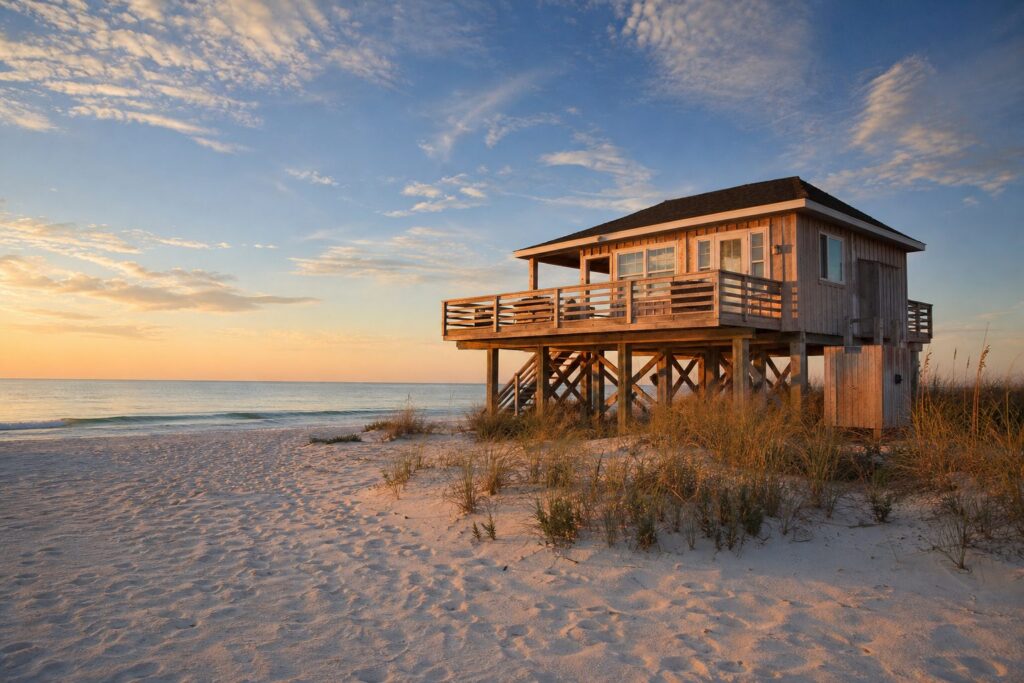
Head east toward Dr. Julian G. Bruce St. George Island State Park and you pass a stretch of vacation rental homes, elevated stilted structures with large decks and outdoor showers. There are no high-rises and the development is not dense. The East End carries no HOA fees whatsoever. Your fixed cost structure drops immediately.
The trade-off? East End cottages typically have lower nightly rate ceilings because you are not offering the gated exclusivity of the Plantation. But you are offering proximity to one of Florida’s most pristine state parks, which is a powerful draw for a specific type of renter: families, nature lovers, and off-season visitors who care more about beach access than a community pool.
Insurance: The Variable That Makes or Breaks Your St. George Island Returns
If there is one thing I tell every investor before they run a single spreadsheet, it is this: get actual insurance quotes before you fall in love with a property.
Citizens, Florida’s state-backed insurer of last resort, covers 115 homes in Franklin County at an average premium of about $2,575 a year, per Move With Momentum data. But that county-wide average dramatically understates what you will actually pay on a beachfront cottage. Gulf-front properties, especially in the Plantation where homes sit directly on the beach, face combined wind, flood, and hurricane premiums that can realistically run $8,000 to $25,000 or more annually, depending on elevation, construction type, and distance from the waterline.
Why does this matter more for the Plantation? Gulf-front Plantation homes tend to be larger and carry higher replacement costs, which drives insurance premiums up. An East End cottage that sits a row or two back from the Gulf, or that was built to newer code with higher elevation, can see materially lower premiums.
So when you are comparing two cottages, do not use the county average. Get property-specific flood zone designations (most of St. George Island falls in FEMA Zone VE or AE) and request quotes from both private carriers and Citizens. The difference between a $7,000 annual premium and a $18,000 annual premium changes your net income picture entirely.
Running the Net Rental Income Comparison on St. George Island
Here is the framework I walk investors through. It is not complicated, but skipping any line item will give you a false picture.
Net Rental Income = Gross Rental Revenue minus Property Management, Insurance, HOA, Property Taxes, Maintenance, Utilities, and Mortgage (if financed)
You need to build this calculation for each specific property you are considering. What I can tell you from having closed over 300 transactions in this market is that investors who run these numbers property-by-property, rather than using island-wide averages, make significantly better decisions.
Key Cost Differences to Map
- HOA Fees: Plantation properties carry $2,000 to $5,000 or more per year. East End properties carry $0.
- Property Management: Both zones typically cost 20% to 30% of gross rental income for full-service vacation rental management.
- Maintenance: Plantation homes tend to be larger with more amenities (pools, extensive landscaping), which increases annual upkeep. Salt air, hurricane exposure, and barrier island logistics elevate maintenance costs island-wide.
- Insurance: Get property-specific quotes. Do not estimate.
- Acquisition Cost: The median single-family sale price on St. George Island is $1,475,000, per hyperlocal data. Plantation homes routinely push above that number, while the East End offers more entry points in the sub-million range.
What Matters Most: Net Yield Per Dollar Invested
A Plantation cottage that grosses $80,000 in rental income but costs $15,000 in insurance and $4,000 in HOA fees nets very differently than an East End cottage that grosses $60,000 with $8,000 in insurance and zero HOA. Once you layer in the higher acquisition cost of the Plantation property, the East End cottage may deliver a stronger cash-on-cash return even though its gross revenue is lower.
What the 2026 St. George Island Market Tells You About Negotiating Power
As of October 2026, per Hitchcock Properties, St. George Island had 104 active listings, an average of 159 days on market, $633.94 average per square foot, and a median list price of $1,199,500. In August 2026, supply reached 25.6 months on the current pace, per Port Realty Group weekly data, which placed the island firmly in buyer’s market territory.
What does that mean for you as an investor? You have room to negotiate. With homes selling at approximately 94.5% of list price across Franklin County, your acquisition cost can come in below asking. Mid-island properties have demonstrated this concretely, with homes selling 5% under list after extended marketing periods. That negotiating leverage directly improves your net yield because every dollar saved on purchase price is a dollar that does not need to be earned back through rental income.
The cash buyer share in Franklin County runs 40% to 55%, per research data. If you are buying with cash, you are in an even stronger position to negotiate because sellers value certainty of close in a slow market.
Seasonal Revenue Patterns and Occupancy Realities on St. George Island
St. George Island’s rental season is heavily concentrated in summer months, roughly May through September. This is true for both the Plantation and the East End, but the shoulder seasons (spring and fall) are where the two zones can diverge.
Plantation properties that offer community amenities may hold occupancy slightly better in shoulder months because guests see value in the pool and tennis courts even when Gulf water temperatures drop. East End properties, meanwhile, benefit from proximity to the state park, which draws birders, hikers, and anglers in cooler months.
What I encourage investors to do is request actual booking histories from the property’s current management company before making an offer. Providing historical bookings data significantly expands the buyer pool to include real estate investors and second-home buyers who require income offset to qualify for financing, and it gives you the real numbers rather than projections.
Frequently Asked Questions
Do Plantation HOA fees on St. George Island include insurance?
No. HOA fees in the St. George Plantation cover community amenities, gated entry, road maintenance, and shared facilities. You still carry your own homeowners, wind, and flood insurance separately. The HOA fee is an additional fixed cost on top of your insurance burden, which is why it is critical to account for both when calculating net rental income.
How much does beachfront insurance cost on St. George Island in 2026?
The county-wide Citizens average is about $2,575 per year, per Move With Momentum data, but that dramatically understates beachfront costs. Gulf-front properties on St. George Island can carry combined wind, flood, and hurricane premiums ranging from $8,000 to $25,000 or more annually, depending on elevation, construction type, and proximity to the Gulf.
Is St. George Island in a FEMA flood zone?
Most of St. George Island falls in FEMA Zone VE or AE, which means flood insurance is required for any federally backed mortgage. Under FEMA’s Risk Rating 2.0 methodology, your premium is individually calculated based on distance to the coast, elevation, and building characteristics. This makes flood insurance a property-specific cost, not a flat rate.
What is the typical property management fee on St. George Island?
Full-service vacation rental management on St. George Island typically runs 20% to 30% of gross rental income, per research data. This covers booking, guest communication, cleaning coordination, and maintenance oversight. That percentage applies equally whether your cottage is in the Plantation or the East End.
Are St. George Island home values going up or down in 2026?
As of mid-2026, per Foreclosure.com, the median home value was approximately $1,034,105, with values showing -0.28% month-over-month and -2.76% year-over-year changes. However, per hyperlocal data, the median sale price per square foot is $619, up 24.5% since last year, meaning smaller, well-positioned homes are still commanding strong per-foot pricing.
How long do homes sit on the market on St. George Island?
As of October 2026, per Hitchcock Properties, the average days on market was 159 days. Per Coastal Realty Group data from mid-2026, the typical time on market was 134 to 140 days. This extended timeline gives you negotiating leverage as a buyer.
Is St. George Island a buyer’s or seller’s market in 2026?
By August 2026, St. George Island had reached 25.6 months of supply on the current pace, per Port Realty Group data, placing it squarely in buyer’s market territory. Homes are selling at approximately 94.5% of list price across Franklin County, giving you room to negotiate below asking.
Can I finance a vacation rental on St. George Island?
Yes. Investment and second-home properties typically require 20% to 25% down payments. DSCR (Debt Service Coverage Ratio) loans are increasingly popular for vacation rental investors because they underwrite based on projected rental income rather than personal income. The current 30-year mortgage rate environment is approximately 6.52%.
What percentage of St. George Island homes are rentals?
A striking 69.5% of St. George Island’s housing units are classified as vacant, per U.S. News & World Report data, which is the clearest indicator that the vast majority of the housing stock serves as vacation homes and short-term rentals. Only 27.5% are owner-occupied and 3.0% are renter-occupied.
Does the East End of St. George Island allow short-term rentals?
Yes. Franklin County has been permissive on short-term rentals, and the East End carries no HOA restrictions that would limit your rental activity. However, any future regulatory changes at the county or state level could impact returns, so this is a factor to monitor in your investment planning.
The Bottom Line
The question is not which zone on St. George Island generates more gross rental revenue. It is which zone delivers more net income after you account for HOA fees, insurance, management, and maintenance. In most scenarios I have evaluated across more than 300 closed transactions, the East End’s zero-HOA cost structure and lower insurance exposure (when you are a row or two back from the Gulf) produce a stronger net return per dollar invested than a Plantation property carrying $4,000 in annual HOA plus elevated Gulf-front insurance premiums. But every property is different, and the numbers only work if you run them on specific cottages with real quotes.
If you are evaluating beachfront cottages on St. George Island, whether in the Plantation or the East End, I would love to walk you through the numbers on specific properties. My family has been on this island since 1968, and with 13 years in real estate and a 5 out of 5 star rating across 33 client reviews, I bring the kind of property-specific knowledge that spreadsheets alone cannot give you. Call me at 850-653-7893 or visit my office at 140 W 1st Street on St. George Island.