True Carrying Costs of a Vacant Beachfront Lot in Gulf County, FL
September 18, 2026 by Melissa Chandler
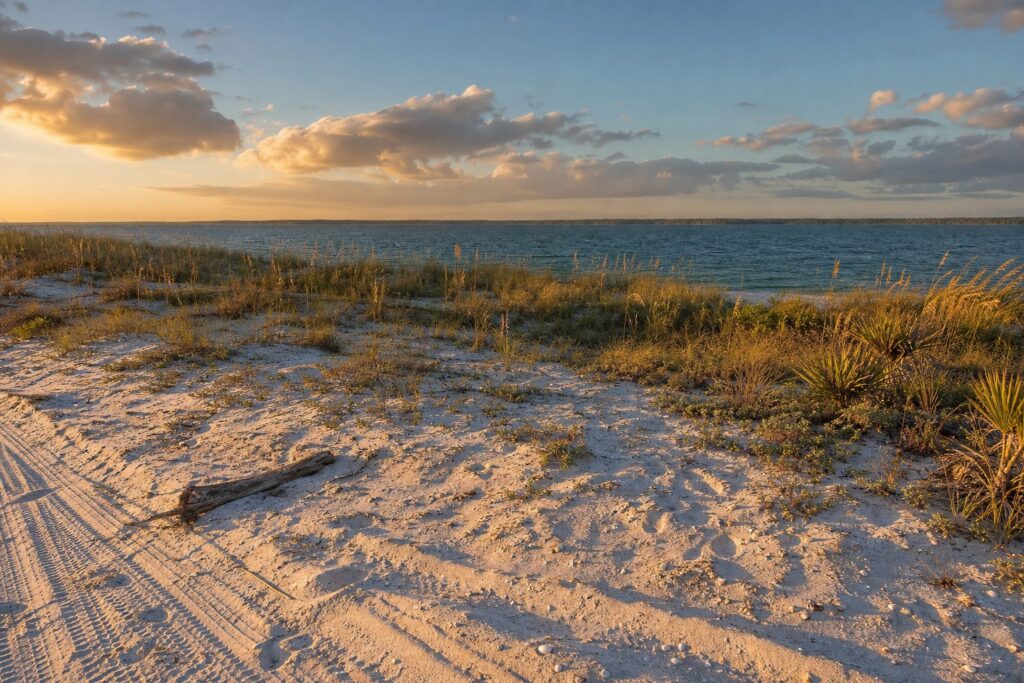
What are the true carrying costs of owning a vacant beachfront lot in Gulf County, FL, in 2026, including taxes, flood insurance, and holding fees before you can build or sell?
Depending on lot value and location, you can expect to pay between $3,000 and $12,000 or more per year in combined property taxes, insurance, maintenance, and assessments on a vacant Gulf County beachfront lot that generates zero income.
Why This Matters Right Now in Gulf County
Here is the reality that catches investors off guard on the Forgotten Coast: a vacant lot does not earn a dime while it sits. No rental income, no offset, nothing. Every month you hold it, money flows out. And on the Florida Gulf Coast, those outflows are not trivial.
I have been working this coastline for over 13 years and have closed more than 300 transactions in the area. The single biggest mistake I see investors make is underestimating carrying costs on vacant beachfront parcels, whether they are on Cape San Blas, along St. Joe Beach, or fronting the Gulf near Indian Pass. They budget for the purchase price and forget to model the bleed.
Gulf County’s total taxable value just topped $4.324 billion for 2026, the highest the county has ever recorded, surpassing 2025 by nearly 9%. That is great news for long-term appreciation. But it also means your assessed values, and therefore your tax bills, are climbing. Let me walk you through exactly what you are signing up for.
Gulf County Property Taxes on Vacant Investment Lots
Property taxes are your most predictable carrying cost, and they are also the one most investors underestimate on non-homesteaded land.
Why Investment Lots Pay More
Florida’s Save Our Homes Amendment caps annual assessment increases at 3% or the change in the Consumer Price Index, whichever is lower. But that protection only applies to homesteaded properties. Your vacant investment lot? It is assessed at full market value every single year with no cap. If Gulf County values jump 9% in a year (as they just did), your tax bill follows.
What the Numbers Look Like
Gulf County’s median effective property tax rate is 0.98%. Within the county, Port St. Joe carries the highest rate at approximately 1.10%, while Wewahitchka comes in at the lowest at 0.82%.
The combined millage in the Port St. Joe area runs approximately 14.5 to 15.5 mills once you add county, school, fire district, and city levies. Here is what that translates to in real dollars:
- $100,000 lot value: approximately $1,450 to $1,550 per year
- $200,000 lot value: approximately $2,900 to $3,100 per year
- $300,000 lot value: approximately $4,350 to $4,650 per year
- $500,000 lot value: approximately $7,250 to $7,750 per year
On top of millage-based taxes, you will also owe non-ad valorem assessments for solid waste, stormwater, and other flat-fee county services, typically adding another $200 to $600 per year.
One investor I worked with last year picked up a beachfront parcel on Cape San Blas for $275,000 and assumed taxes would run about $1,500. The actual bill came in closer to $3,800 once all levies were included. That is a meaningful difference when the lot is sitting empty.
Flood Insurance on Gulf County Beachfront Parcels
This is where coastal lot ownership gets tricky, and where I spend the most time educating my clients.
The Vacant Lot Paradox
Most beachfront parcels in Gulf County, from Cape San Blas Road all the way down to Indian Pass, fall within FEMA VE zones (coastal high-hazard with velocity wave action) or AE zones. Here is the catch: the NFIP does not offer building coverage on a vacant lot because there is no structure to insure.
So do you need flood insurance right now? If you own the lot free and clear with no lender, technically no. But the moment you break ground on construction, flood insurance becomes mandatory, and it is expensive. VE zone premiums for beachfront properties in this part of the Panhandle run $3,000 to $8,000 or more annually, and some high-exposure Gulf-front positions push well above that. Understanding what are the true costs of buying a home including insurance obligations can help you model your complete acquisition picture.
What You Should Budget During the Holding Period
- Vacant lot with no mortgage: $0 to approximately $500 per year if you obtain a private policy for liability coverage
- Lot under active construction (VE zone): $3,000 to $8,000 or more per year
- Completed beachfront home (VE zone): $5,000 to $15,000 or more per year
Starting in 2026, you will need flood insurance to obtain Citizens Property Insurance wind coverage for any home insured at $400,000 or above. By 2027, that flood requirement expands to homes of any value. If your exit strategy involves building and selling, those costs flow directly into your construction budget.
Hidden Holding Fees Most Gulf County Investors Overlook
Taxes and insurance get all the attention. But the smaller recurring costs add up faster than you would expect on a beachfront lot sitting in the salt air.
Lot Maintenance and Code Compliance
Gulf County requires property owners to keep lots maintained. Beachfront parcels may need less traditional mowing, but sand management, debris removal after storms, and vegetation control are ongoing tasks. Budget $600 to $1,800 per year depending on lot size and accessibility.
HOA and Community Assessments
If your lot sits within a community like Jubilation on Cape San Blas, you are paying HOA dues whether the lot is improved or not. HOA fees in Gulf County range from $106 to $3,250 per month. Even on the lower end, that is $1,272 per year on a lot generating nothing.
Opportunity Cost of Tied-Up Capital
What I tell my investors is this: if you have $300,000 sitting in a vacant lot earning zero, the opportunity cost at even a conservative 5% return is $15,000 per year you are not earning elsewhere. That invisible cost never shows up on a spreadsheet, but it should factor into every hold-versus-sell decision you make.
A couple from Atlanta I worked with recently held a beautiful Gulf-front lot near St. Joe Beach for three years before deciding to build. When we tallied up their cumulative carrying costs, including taxes, HOA fees, maintenance, and one private flood policy, they had spent over $28,000 before a single nail was driven. They told me they wished they had run those numbers on day one so they could have planned their timeline more intentionally.
Building Timeline and How It Extends Your Carrying Costs in Gulf County
Even once you commit to building, the clock does not stop. Build time on new construction in this market runs roughly 9 to 10 months for production builders and up to 12 months for custom homes. During that entire period, you are paying carrying costs on the lot plus construction loan interest, insurance, and permitting fees.
And here is something worth knowing: with only 53 residential sales year-to-date in Gulf County and homes sitting on the market an average of 121 days (up from 103 days last year), liquidity is thin. If your exit strategy is to sell the completed home, you need to build that extended sales timeline into your cost model too.
With 13 years of experience and a family history on this coast stretching back to 1968, I have seen cycles come and go. The current market reflects long-term stability, but it rewards investors who plan carefully and model conservatively. The Florida Gulf Coast real estate market here continues to demonstrate resilience even as carrying costs climb.
Complete Annual Carrying Cost Summary for Gulf County Beachfront Lots
Let me put the full picture together for you, using a $300,000 vacant Gulf-front lot in the Port St. Joe or Cape San Blas area as a baseline:
- Property taxes (no homestead): approximately $4,350 to $4,650
- Non-ad valorem assessments: approximately $200 to $600
- Flood insurance (vacant, private policy): $0 to $500
- Lot maintenance and debris management: $600 to $1,800
- HOA fees (if applicable): $1,272 to $6,000 or more
- Estimated total annual carrying cost: approximately $6,400 to $13,550
That is real money leaving your pocket every year on a lot that produces nothing until you build or sell. Over a three-year hold, you could be looking at $20,000 to $40,000 in cumulative carrying costs before any appreciation is realized.
Frequently Asked Questions
Do I have to pay property taxes on a vacant lot in Gulf County?
Yes. Every parcel in Gulf County is subject to property taxes whether improved or vacant. As an investor, you will not qualify for Florida’s homestead exemption, which means your lot is taxed at full assessed market value every year with no cap on annual increases.
How much is flood insurance on a vacant beachfront lot in Gulf County?
For a truly vacant lot with no mortgage, you may not be required to carry flood insurance. However, some investors obtain private policies for $0 to $500 per year. The moment construction begins in a VE zone, premiums jump to $3,000 to $8,000 or more annually.
What is the millage rate in Gulf County for 2026?
The county millage is 5.60 mills. When you add school, fire district, and city levies (in Port St. Joe), the combined rate runs approximately 14.5 to 15.5 mills. Exact rates depend on which taxing districts your parcel falls within.
Are there HOA fees on vacant lots at Cape San Blas?
Many communities, including Jubilation on Cape San Blas, require HOA dues on all lots regardless of whether a home has been built. These fees range from $106 to $3,250 per month across Gulf County.
How long does it take to build a home in Gulf County?
Current build timelines run approximately 9 to 10 months for production homes and up to 12 months for custom construction. During this entire period, carrying costs continue to accrue alongside construction loan interest.
Can I avoid property tax increases on my Gulf County investment lot?
No. Florida’s Save Our Homes cap only protects homesteaded primary residences. Non-homesteaded investment property is reassessed at full market value every year with no limitation on increases.
What are the non-ad valorem assessments on Gulf County vacant lots?
Expect approximately $200 to $600 per year for solid waste, stormwater, and related county service assessments. These are flat fees independent of your property’s assessed value.
How liquid is the Gulf County real estate market in 2026?
The market is relatively thin. Only 53 residential sales had closed year-to-date as of the most recent data, and average days on market increased to 121 days from 103 the prior year. Plan for extended hold times. Population and demographic data for Gulf County, Florida show this is a stable but slower-growth market compared to major metros.
Is Gulf County property still appreciating in 2026?
Total taxable values hit $4.324 billion in 2026, up 8.96% from 2025. Long-term appreciation trends remain positive, though the pace of new construction has slowed for the second consecutive year. Check out the latest St. George Island real estate market updates for current conditions and trends.
Should I carry windstorm insurance on a vacant lot in Gulf County?
A vacant lot typically does not require windstorm insurance since there is no structure to protect. However, once construction begins, windstorm coverage becomes essential. Gulf County’s coastal location places it in a moderate-to-high premium range statewide.
The Bottom Line
Owning a vacant beachfront lot in Gulf County is not a passive investment. It is an active financial commitment that demands careful modeling. Between property taxes, potential insurance, HOA dues, and maintenance, you could be spending $6,000 to $13,000 or more per year before you ever build or sell. The Forgotten Coast remains one of the last stretches of undeveloped Gulf coastline in Florida, and the long-term fundamentals here are strong. But going in with clear eyes on the true carrying costs is what separates smart investors from frustrated ones. If you are evaluating a vacant beachfront parcel in Gulf County, from Cape San Blas to St. Joe Beach to Indian Pass, I am happy to walk through the numbers with you. With over 300 transactions closed and 33 five-star reviews from past clients, I have helped investors on this coast for over 13 years. Give me a call at 850-653-7893 or reach out through Melissa Chandler Real Estate on St. George Island. Let’s make sure the numbers work before you write the check.