St. George Island Erosion Trends and Beachfront Investment Resale Value in 2026
November 23, 2026 by Melissa Chandler
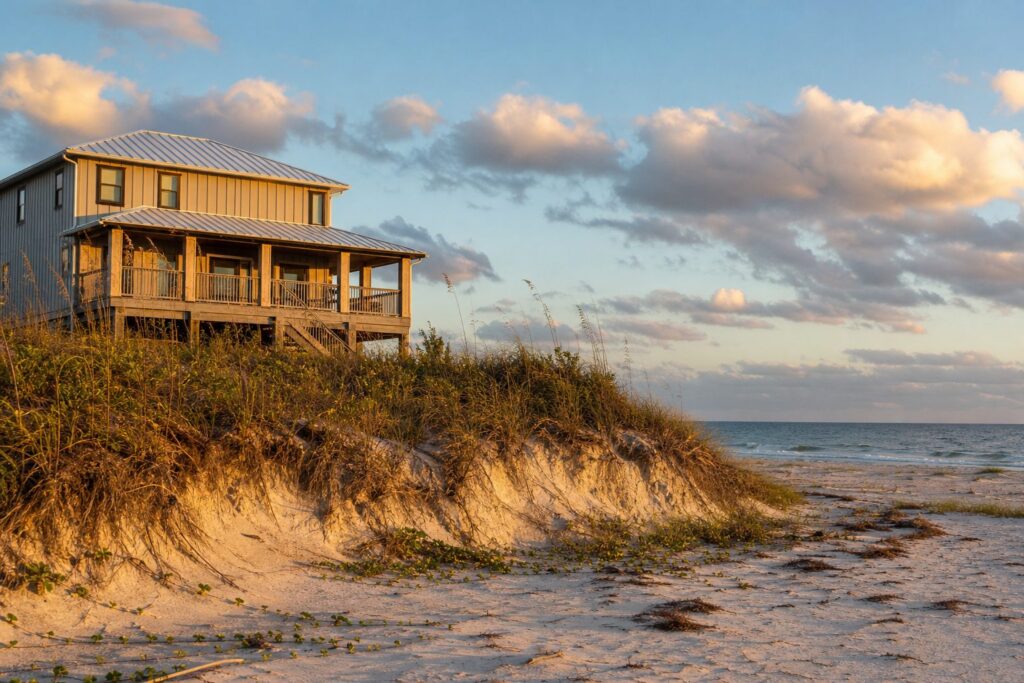
What are the erosion and shoreline loss trends on St. George Island in 2026, and how do they affect the long-term resale value of my beachfront investment property?
St. George Island’s shoreline has remained relatively stable along much of its outer coast over the past century, but localized segments, particularly east of Bob Sikes Cut near the Plantation, carry a critical erosion designation from the Florida DEP, and that distinction directly shapes what your property will be worth at resale.
Why St. George Island Erosion Matters to Investors Right Now
If you are evaluating beachfront homes for sale on St. George Island, erosion is not a hypothetical future concern. It is a present-day factor shaping insurance costs, regulatory constraints, and buyer confidence. With 13 years of experience and over 300 closed transactions on Florida’s Forgotten Coast, I can tell you that the conversation around erosion has shifted dramatically in just the last few years. Buyers today ask sharper questions. Lenders scrutinize flood zone designations more carefully. And sellers who cannot articulate their property’s relationship to the shoreline often watch their listing sit.
The island’s average elevation sits at approximately 7 feet above sea level, according to USGS data. Sea-level rise along the northern Gulf Coast has averaged about 1 foot from 1867 to 2015, with local gauges recording rises of approximately 0.7 feet near St. George Island over that period. At recent rates of 2 to 3 millimeters per year, as reported by USGS, dune breaching and saltwater intrusion during storms are accelerating. For your investment, understanding exactly where your property sits relative to these trends can be the difference between a profitable hold and a costly exit.
How St. George Island’s Geology Creates Erosion Patterns
You need to understand what kind of island you are buying on. St. George Island is a 22-mile barrier island, and barrier islands are, by their very nature, dynamic. According to the Florida Geological Survey’s Winter 2026 Newsletter, high-energy Gulf waves continuously deposit and erode sediment along the shoreface, while wind processes build and reshape the dune systems behind them. The island’s primary sediment source is the Apalachicola River, the largest river by water volume in Florida. Longshore currents carry that sediment along the shoreline, and over time, these currents can literally reposition entire barrier islands down-current.
What does this mean for you as an investor? It means no beachfront lot on St. George Island is static. The sand under and in front of your property is always in motion. Some areas gain sand over time, while others lose it. The critical distinction is knowing *which* segments are accreting and which are eroding.
The Critical Erosion Zone Near the Plantation
The Florida Department of Environmental Protection has designated segments east of Bob Sikes Cut, particularly in the St. George Island Plantation area, as critically eroding. Recent FDEP assessments have noted eastward progression of erosion by 0.6 miles in affected Franklin County segments, threatening both habitats and property. If you are looking at St. George Island houses in that eastern stretch, this designation should be front and center in your due diligence.
Along the Town Center and Gulf Beaches corridor, where E. Gulf Beach Drive and W. Gulf Beach Drive frame the island’s commercial heart near the Cape St. George Lighthouse, the shoreline has been comparatively more stable. But “stable” on a barrier island is a relative term, not an absolute promise.
What Hurricane History Tells You About St. George Island Resale Risk
You cannot evaluate St. George Island real estate without confronting the hurricane question head-on. Hurricane Michael in 2018 was the defining event for this stretch of coastline. According to USGS data, Michael made landfall as a Category 5+ hurricane just 45 miles northwest of St. George Island near Tyndall Air Force Base. The USGS recorded a 100% predicted probability of overwash for the island. Low-elevation dunes were overtopped by storm surge and large waves, and sand was transported from the beach and dunes, covering the only access road into St. George Island State Park. The Florida DEP categorized the resulting damage as Erosion Condition IV, their most severe classification for major beach and dune erosion.
What I always explain to my investment clients is this: the island rebuilt. Properties were repaired. Vacation rental revenue recovered. But the storm left behind a changed shoreline, and buyers arriving today need to understand the post-Michael landscape, not the pre-Michael one. The dune systems that once buffered certain Gulf-front properties are thinner now in some segments. That changes your insurance calculus, your maintenance projections, and ultimately your exit price.
Dune Restoration Efforts and What They Mean for Your St. George Island Investment
Franklin County has invested in dune restoration, and that investment matters to your bottom line. Post-Hurricane Michael recovery plans called for dune restoration at St. George Island Plantation (R52 to R73) and along the broader St. George Island corridor (R74 to R105), each consisting of 200,000 cubic yards of sand placement at an estimated $25 per cubic yard, according to Franklin County’s RESTORE plan. The county’s RESTORE-funded County-Wide Dune Restoration project covers approximately 11 miles of shoreline with a $2.1 million budget, with a beach and dune restoration project in the planning stages for construction in 2025 and 2026.
Here is a crucial detail, though. SBEACH modeling analysis showed that Type B dune construction provides storm protection improvements only up to roughly a 30-year storm event. The dunes would not protect upland structures from a 50-year storm and would be completely eroded during that level of event.
And here is something that should factor into your investment thesis: the FDEP FY2026-27 Long-Range Budget Plan for the Beach Management Funding Assistance Program does not list a St. George Island beach nourishment project among its funded construction projects. The island is currently relying on smaller-scale dune restoration rather than the large-scale federal and state nourishment projects that protect other Florida beaches. That gap matters.
How Erosion Directly Impacts St. George Island Property Values in 2026
So what does all of this mean in dollars? The St. George Island real estate market in 2026 tells a nuanced story. According to Port Realty Group weekly market reports, the median sale price on St. George Island sits at approximately $1,152,500, down roughly 5% year over year as of 2026. As of October 2026, per Hitchcock Properties data, the island showed 104 listed properties with 159 average days on market, an average price per square foot of $633.94, and a median list price of $1,199,500.
The sale-to-list ratio has settled around 94% to 95%, meaning buyers are regularly closing 5% to 6% below asking price, per Port Realty Group data. Active inventory is up approximately 49% over three years.
What is striking is the divergence between St. George Island and comparable coastal markets. The island’s median price per square foot of $511 as of mid-2026 was down 18.6% year over year, per market analysis from RentRelaxVR, while comparable Cape San Blas declined only about 1% over the same period. While some of this reflects the small monthly sales count and mix shifts in property types, the trend line warrants your attention.
The Regulatory Squeeze on Beachfront Lots
Franklin County’s Comprehensive Plan imposes density limits, floor-area ratios that cannot exceed 1.0 on much of St. George Island, and a dedicated St. George Island Overlay District regulating setbacks, heights, and landscaping for erosion control. The Coastal Construction Control Line (CCCL) further restricts development seaward of the line. If you purchase a beachfront property that sits close to or seaward of the CCCL, your ability to rebuild, expand, or even make significant improvements may be severely limited. That constraint directly affects resale value because your buyer pool narrows to purchasers willing to accept those same restrictions.
Smart Strategies for Protecting Your St. George Island Beachfront Investment
Having closed over 300 transactions on this stretch of coast, I have watched investors succeed and struggle. The ones who do well approach erosion risk with clear eyes and a solid plan.
- Understand your lot’s specific erosion history. Not the island average, but the precise segment. Request FDEP shoreline change data for the range monument nearest your property.
- Budget for elevated insurance costs. Barrier island properties carry premium wind and flood insurance. Factor those numbers into your cap rate analysis before you buy, not after.
- Favor properties with healthy dune systems. The dune between your house and the Gulf is your first line of defense. Properties behind robust, vegetated dunes hold value more reliably.
- Consider bayside or mid-island positions. Streets like Canopy Lane, Turpentine Trail, and lots along Gorrie Drive offer bay views, boat dock access, and meaningful insulation from Gulf-side erosion, often at lower price points.
- Watch the nourishment pipeline. If a large-scale beach nourishment project is funded for St. George Island in future budget cycles, that could meaningfully support Gulf-front values.
Frequently Asked Questions
Is all of St. George Island experiencing erosion in 2026?
No. Much of the outer coast has shown relatively stable shoreline positions over the past century, according to FDEP assessments. The critical erosion designation is concentrated in segments east of Bob Sikes Cut, particularly near the St. George Island Plantation area, where storm impacts have been most severe.
How much has sea level risen near St. George Island?
Local gauges have recorded sea-level rise of approximately 0.7 feet near St. George Island since the mid-1800s, with recent rates hovering at 2 to 3 millimeters per year, according to USGS data. That rate accelerates dune breaching and saltwater intrusion during high tides and storms.
Are there any major beach nourishment projects planned for St. George Island?
As of the FDEP FY2026-27 Long-Range Budget Plan, no large-scale beach nourishment project is listed among funded construction projects for St. George Island. The county is relying on smaller-scale RESTORE-funded dune restoration covering approximately 11 miles of shoreline with a $2.1 million budget.
How does erosion affect my vacation rental income on St. George Island?
Your rental revenue depends heavily on beach access and beach quality. When evaluating owning a vacation rental on St. George Island, island-wide annual gross revenue averages approximately $49,847 per listing, with average daily rates between $470 and $545, according to RentRelaxVR data as of 2026. Properties on eroding segments may face diminished guest appeal over time.
What cap rate can I expect from a Gulf-front property on St. George Island?
Understanding the average cap rate for vacation rental properties on St. George Island is essential. A Gulf-front home priced at $1.5 million with $75,000 in gross revenue and 40% operating expenses produces roughly $45,000 in NOI, yielding approximately a 3.0% cap rate, per RentRelaxVR analysis. High insurance and maintenance on erosion-prone lots can push that figure even lower.
Does the Coastal Construction Control Line affect my property’s resale value?
Yes. Properties seaward of the CCCL face restrictions on construction, reconstruction, and improvements enforced by the Florida DEP. These restrictions narrow your buyer pool at resale and can limit your ability to rebuild after storm damage, which directly impacts long-term value.
How did Hurricane Michael change the St. George Island shoreline?
Hurricane Michael in 2018 caused Erosion Condition IV damage, the most severe FDEP classification. The USGS recorded 100% predicted probability of overwash. Low-elevation dunes were overtopped, and sand was transported across the island, covering the access road to St. George Island State Park.
Are bayside properties a safer investment than Gulf-front on St. George Island?
Bayside lots along Gorrie Drive and mid-island streets like Canopy Lane face significantly less erosion risk. While they do not command the same price premium as Gulf-front homes, their lower insurance costs, reduced maintenance burden, and stable shoreline position can produce stronger risk-adjusted returns over a long hold.
What is the current median home price on St. George Island?
The median sale price is approximately $1,152,500, down about 5% year over year, with homes sitting on market 101 to 133 days, per Port Realty Group weekly reports from 2026. The median list price was $1,199,500 as of October 2026, per Hitchcock Properties data.
Should I invest in St. George Island beachfront property despite erosion concerns?
Erosion risk does not eliminate opportunity. It demands smarter buying. Focus on segments with stable shoreline histories, healthy dune buffers, and properties built to current wind and flood codes. Work with a listing agent who specializes in St. George Island and understands the specific erosion profile of each lot, not just island-wide averages.
The Bottom Line
St. George Island remains one of Florida’s most compelling coastal investment markets precisely because its geography cannot be replicated or expanded. But investing here without understanding erosion trends is like buying a rental property without checking the roof. The data tells a clear story: some segments of the island are well-buffered and stable, while others carry critical erosion designations that will shape your insurance costs, regulatory options, and exit price for years to come.
With 33 five-star reviews, over 300 transactions closed, and a lifetime of connection to this island, I help investors see not just the listing sheet but the full picture, including what the shoreline looked like five years ago and where it is heading. If you are evaluating St. George Island homes for sale and want to make a decision grounded in real data, give me a call at 850-653-7893 or visit my office at 140 W 1st Street on St. George Island. I would love to walk you through the numbers and the shoreline, in person.
*Melissa Chandler, Realtor, Berkshire Hathaway HomeServices Beach Properties of Florida. Florida License SL3280547. Equal Housing Opportunity.*