Capital Gains Tax on Selling a St. George Island Vacation Rental in 2026
November 23, 2026 by Melissa Chandler
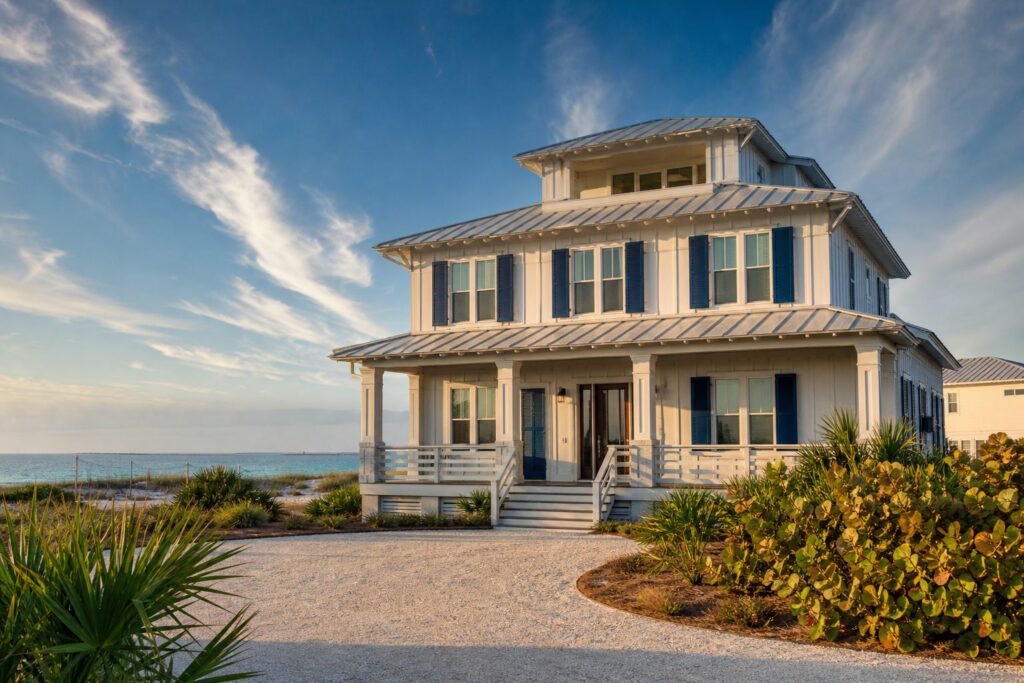
What are the capital gains tax implications of selling my St. George Island vacation rental property in 2026, and how do depreciation recapture rules affect my net proceeds?
If you sell your St. George Island vacation rental in 2026, expect to owe federal capital gains tax at 15% to 23.8% on your profit, plus a separate 25% tax on all depreciation you have claimed. Florida charges no state income tax, which is a meaningful advantage.
Why This Matters for St. George Island Property Owners Right Now
This question is landing on my desk more often than any other this year, and the reason is straightforward. The St. George Island market is in a measured correction, with the median sale price sitting around $1,175,000, down roughly 3% year-over-year according to trailing 12-month closed transaction data. Active inventory has climbed approximately 49% over three years, and sellers are accepting an average of 5.82% below asking price.
For investors who purchased during the 2020 to 2022 surge, that combination of softening values, compressed rental ADR (average daily rates fell roughly 23% year-over-year per September 2026 managed portfolio data), and rising insurance costs is forcing a hard question: should I sell now and lock in my gains, or hold? The answer depends entirely on your after-tax proceeds. And that number is shaped more by depreciation recapture than most owners realize. Having helped investors navigate over 300 transactions across Florida’s Forgotten Coast over the past 13 years, I can tell you this: the tax math changes the decision more often than the market math.
How Federal Capital Gains Tax Applies to Your St. George Island Sale
When you sell a vacation rental you have held for more than one year, your profit is taxed as a long-term capital gain. For 2026, the federal rates break down like this:
- 0% rate applies to taxable income up to approximately $48,350 for single filers or $96,700 for married filing jointly
- 15% rate applies to single filers with taxable income between approximately $48,351 and $533,400, or married filing jointly between approximately $96,701 and $600,050
- 20% rate applies above those thresholds
Here is the part that catches many St. George Island sellers off guard. If your modified adjusted gross income exceeds $200,000 (single) or $250,000 (married filing jointly), you also owe the Net Investment Income Tax (NIIT) of 3.8% on top of your capital gains rate. Those NIIT thresholds are not indexed for inflation, which means more sellers hit them every year.
So what does that look like in practice? Given that St. George Island homes for sale are trading in the $900,000 to $2,300,000 range, most sellers I work with land in the 18.8% to 23.8% effective federal rate on their capital gain. That is a significant slice of your proceeds, and we have not even addressed depreciation recapture yet.
Depreciation Recapture on St. George Island Rental Properties: The Hidden Tax Hit
This is the tax event that consistently surprises my clients. Here is how it works.
How Depreciation Creates a Future Tax Liability
When you placed your St. George Island vacation rental into service, you began depreciating the building portion (not the land) over 27.5 years using straight-line depreciation, per IRS Publication 527. Every year, that deduction reduced your taxable rental income. That felt like a benefit at the time, and it was.
But when you sell, the IRS recaptures every dollar of depreciation you claimed, and here is the critical point: even depreciation you should have claimed but did not gets recaptured. The recapture is taxed at a maximum rate of 25% under Section 1250 unrecaptured gain rules. This is a separate, higher rate than the long-term capital gains rate on the rest of your profit.
A Realistic St. George Island Scenario
Let me walk through the numbers so you can see the impact. Say you purchased a Gulf-view home on the island for $1,000,000. Land on a barrier island like St. George Island typically accounts for about 20% of purchase price, leaving $800,000 as the depreciable building value. Over seven years of ownership, you claimed annual depreciation of approximately $29,091, totaling roughly $203,636.
Your adjusted basis drops to approximately $796,364. If you sell at the current median of around $1,175,000, your total gain is approximately $378,636. But that gain gets split into two tax buckets:
- Depreciation recapture portion: $203,636 taxed at up to 25%, producing roughly $50,909 in federal tax
- Remaining capital gain: $175,000 taxed at 15% to 20%, producing roughly $26,250 to $35,000
- NIIT at 3.8% on the full gain (if applicable): approximately $14,388
Your total estimated federal tax bill in this scenario ranges from roughly $91,547 to $100,297. That is real money, potentially 8% to 9% of your sale price, and it comes directly out of your net proceeds at closing.
Florida’s No State Income Tax Advantage for St. George Island Sellers
Here is some genuinely good news. Florida has no state income tax. If you are selling a vacation rental in a state like California, New York, or New Jersey, you would owe an additional 5% to 13% in state taxes on top of everything I just described. On a $378,636 gain, that could mean an extra $19,000 to $49,000 walking out the door.
Your St. George Island property sits in Franklin County, Florida, and that zero-state-tax advantage is one of the structural benefits of investing on this barrier island. It is also why I see so many out-of-state investors choosing Florida’s Forgotten Coast, including St. George Island, over comparable coastal markets in higher-tax states.
Five Strategies to Reduce Your Tax Burden When Selling on St. George Island
You are not powerless here. Let me walk through the most common approaches I discuss with my investor clients.
1031 Exchange: Deferring Both Capital Gains and Depreciation Recapture
A Section 1031 like-kind exchange allows you to defer both your capital gains tax and your depreciation recapture by reinvesting into another qualifying investment property. You must identify your replacement property within 45 days and close within 180 days. The property you are selling must have been held for investment use, not primarily personal use, so your rental history and usage records matter enormously. For detailed guidance on how Section 1031 exchanges work, review IRS Topic 409.
Installment Sale to Spread the Tax Hit
If you do not want to exchange into another property, an installment sale allows you to spread your gain across multiple tax years by carrying back a portion of the purchase price as seller financing. This can keep you in a lower capital gains bracket each year.
Cost Basis Adjustments You May Be Missing
Capital improvements you have made over the years, think new roofing, HVAC systems, pool additions, or hurricane-resistant windows (common on St. George Island properties), add to your cost basis and reduce your taxable gain. Many sellers I work with on the island have spent $50,000 to $150,000 on storm-resilience upgrades that they forget to account for. Keep those receipts.
Timing Your Sale Around Income Events
If your income varies year to year, timing your sale to a lower-income year can drop you into a lower capital gains bracket, potentially saving 5% or more on the gain.
Offsetting Gains with Capital Losses
Capital losses from other investments, whether stocks, other real estate, or business ventures, can offset your capital gains dollar for dollar in the same tax year.
What the Current St. George Island Market Means for Your Tax Decision
Should you sell now or wait? The tax picture is only part of the equation, but it is an important part. Here is what I am seeing.
St. George Island homes for sale currently number between 208 and 219 active listings, per late 2026 market data. The sale-to-list ratio sits at approximately 94%, and the median days on market has stretched to 85 days according to recent market reporting, with some sources showing 130 days for November 2026 listings. This is a buyer’s market by any objective measure.
If values continue to soften, waiting means a potentially lower sale price with the same depreciation recapture tax. With 13 years and over 300 closed transactions on Florida’s Forgotten Coast under my belt, what I tell my clients is this: run the after-tax numbers now, not after you have already listed. The difference between selling at $1.2 million and $1.1 million is not $100,000 in your pocket. After taxes, closing costs, and recapture, that gap narrows dramatically.
Frequently Asked Questions
Do I owe capital gains tax if I convert my St. George Island rental to a primary residence before selling?
You may qualify for the Section 121 exclusion ($250,000 single, $500,000 married filing jointly) if you live in the home as your primary residence for at least two of the five years before the sale. However, post-2008 rules require you to pay capital gains on any gain allocated to periods of non-qualified use. For more information, see IRS Publication 523. Depreciation recapture is not eliminated by this conversion.
What is the depreciation recapture tax rate for 2026?
The maximum federal rate on unrecaptured Section 1250 gain (depreciation recapture on real property) is 25%. This applies regardless of your income bracket and is separate from the long-term capital gains rate on the rest of your profit.
Does Florida charge any tax on my St. George Island property sale proceeds?
No. Florida has no state income tax, so your entire capital gains and depreciation recapture tax obligation is federal. This is a significant advantage over selling rental properties in high-tax states.
Can a 1031 exchange help me avoid depreciation recapture?
Yes. A properly executed 1031 exchange defers both capital gains tax and depreciation recapture. The deferred depreciation carries over to your replacement property. You must follow strict identification and closing timelines.
What happens if I never claimed depreciation on my St. George Island rental?
The IRS taxes you on depreciation you were “allowed or allowable,” meaning even unclaimed depreciation is subject to recapture at the 25% rate. If you have not been claiming depreciation, you should consult a tax professional immediately because you have been missing deductions without avoiding the future tax.
How do I calculate my adjusted basis for my St. George Island property?
Start with your original purchase price, add capital improvements (new roof, pool, HVAC, hurricane shutters), subtract all depreciation claimed or allowable, and subtract any casualty losses previously deducted. The difference between your sale price and adjusted basis is your total taxable gain.
Does the 3.8% Net Investment Income Tax apply to my rental property sale?
Yes, if your modified adjusted gross income exceeds $200,000 (single) or $250,000 (married filing jointly). Given that St. George Island real estate values typically produce gains well above these thresholds, most sellers on the island will owe the NIIT.
Can I deduct my selling costs to reduce capital gains?
Absolutely. Real estate commissions, transfer taxes, title insurance, attorney fees, and other closing costs reduce your amount realized, which directly lowers your taxable gain. These deductions matter when you are dealing with six- and seven-figure sale prices.
Is there a way to avoid depreciation recapture entirely?
The only ways to completely avoid depreciation recapture are holding the property until death (your heirs receive a stepped-up basis) or donating the property to a qualified charity. A 1031 exchange defers, but does not eliminate, the recapture.
Should I sell my St. George Island rental before or after year-end 2026?
Timing depends on your total income picture for 2026 versus 2027. If your income is unusually high this year, deferring to January could place you in a lower bracket. If 2026 is a lower-income year, closing before December 31 may save you money. Work with a tax advisor who understands real estate investment sales.
The Bottom Line
Selling your St. George Island vacation rental in 2026 involves more than watching the market and picking a list price. Depreciation recapture at up to 25%, long-term capital gains at 15% to 23.8%, and the 3.8% NIIT can collectively claim a meaningful share of your proceeds. Florida’s zero state income tax helps, but the federal bill alone demands careful planning.
I am Melissa Chandler with Berkshire Hathaway HomeServices Beach Properties of Florida, and I have spent over 13 years helping investors buy, hold, and sell on St. George Island with over 300 transactions closed and 33 five-star reviews from clients who trust the guidance I provide. If you are weighing whether to sell your St. George Island property, let’s run the real numbers together, after-tax, so you can make a confident decision. Reach me at 850-653-7893 or visit my office at 140 W 1st Street on St. George Island. The best time to plan is before you list.
*Equal Housing Opportunity. Melissa J. Chandler, Licensed Florida Real Estate Agent (License SL3280547), affiliated with Berkshire Hathaway HomeServices Beach Properties of Florida. All information deemed reliable but not guaranteed. This content is for educational purposes and does not constitute tax advice. Consult a qualified tax professional for guidance on your specific situation.*