Dark Sky and Sea Turtle Ordinances on St George Island: What Buyers Need to Know
September 22, 2026 by Melissa Chandler
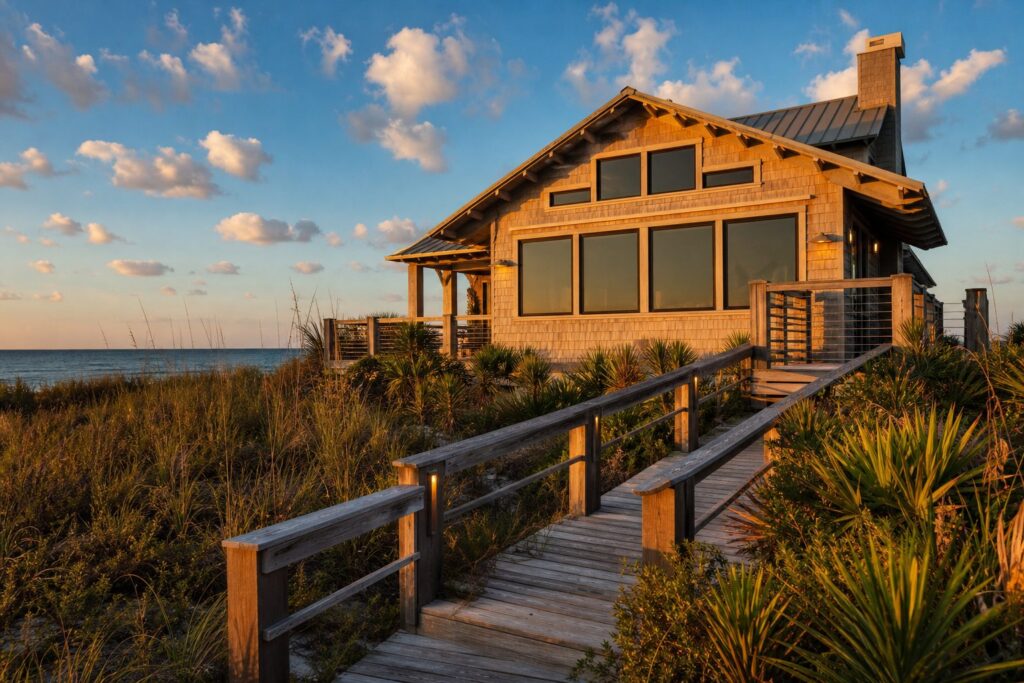
What are the dark sky and sea turtle nesting ordinances on St George Island, and how do they affect what you can build or modify on a second home property in 2026?
Franklin County’s sea turtle lighting ordinance requires all exterior lighting on St George Island to be amber or red, fully shielded, and downward-directed, and all windows visible from the beach must be tinted or covered during nesting season from May through October.
Why These Ordinances Matter for St George Island Buyers Right Now
If you’re shopping for St George Island real estate in 2026, these regulations are not fine print you can deal with later. They will shape your building plans, your renovation budget, and even how you enjoy your property on a summer evening.
I grew up on this coast. My family moved here in 1968, and I’ve watched this island evolve while remaining fiercely committed to its natural character. The lighting regulations here are a big part of why St George Island still looks, feels, and sells the way it does. There are no high-rise condos, no traffic lights, and roughly 1,000 residents who like it that way. The turtle ordinance and the emerging dark sky efforts are not obstacles. They are the very things protecting what makes property here valuable in the first place.
With the median sale price on St George Island hitting $1,200,000 in July 2026 and prices up 13.8% year-over-year, the market is telling you something: buyers pay a premium for places that protect their natural environment. Understanding these ordinances before you buy or build is not optional. It is essential.
The Franklin County Sea Turtle Lighting Ordinance on St George Island Explained
Here is what you need to know about the legal framework. Florida Statutes Section 161.163 requires the Department of Environmental Protection to designate coastal nesting areas and establish lighting guidelines. Franklin County passed its own turtle lighting ordinance in 1998, and it applies to every property on St George Island, whether you are on the Gulf side, the bay side, or tucked into the interior along E. Gulf Beach Drive.
The nesting season runs from May 1 through October 31. During those six months, female loggerhead turtles come ashore at night to lay eggs. About 45 to 60 days later, up to 150 baby turtles can hatch from a single nest. Current research shows that only one in every 5,000 hatchlings survives to adulthood, which is why artificial light disorienting them is such a serious issue.
The Florida Fish and Wildlife Conservation Commission boils the lighting requirements down to three golden rules:
- Keep it LOW. Mount fixtures as close to the ground as possible.
- Keep it LONG. Use only long-wavelength light at 560 nanometers or greater, meaning amber, orange, or red LEDs exclusively.
- Keep it SHIELDED. Every fixture must be fully downward-directed so neither the bulb nor any glowing lens is visible from the beach.
So what does that actually look like when you’re standing on your deck watching the sunset? It means your porch light is a warm amber glow pointed straight down. It means your decorative string lights facing the Gulf are not allowed. And it means the investment you make in compliant fixtures is an investment in the place itself.
How St George Island Building and Renovation Projects Are Affected in 2026
Whether you are building from scratch or renovating an older cottage on the island, the ordinance touches nearly every exterior and some interior elements. I have helped more than 300 buyers and sellers navigate St George Island homes for sale over my 13 years in this business, and I can tell you that the buyers who understand these requirements upfront avoid costly surprises down the road.
Exterior Lighting Requirements
- Deck and porch lights must be fully shielded and use amber, orange, or red LEDs. Carriage lights, globe lights, and any fixture that scatters light in all directions must be replaced with directional or recessed alternatives.
- Landscape and uplighting is prohibited if visible from the beach. That means no accent lights on your palm trees if your lot faces the Gulf.
- Dune walkovers and boardwalk lighting must be recessed, shielded, and long-wavelength only.
- String lights and decorative runner lights are not permitted in areas visible from the nesting beach.
Windows, Glass, and Interior Light
This is the one that surprises most buyers. If your home has windows facing the beach, you must install tinting that meets a 45% or lower inside-to-outside transmittance standard, or you must use blackout curtains and blinds during nesting season. Darker tints down to 15% transmittance have been used successfully on homes with large glass walls.
One couple I worked with last year fell in love with a Gulf-front home near the East End, but they had envisioned floor-to-ceiling glass without any tinting. Once we walked through the ordinance together, they realized the tinted glass actually reduced their cooling costs and glare while keeping them compliant. They ended up choosing a 25% tint and have not looked back.
Pools, Parking Areas, and Outdoor Living
Pool lighting must comply with the same shielding and wavelength requirements. Parking area lighting and beach access points fall under the Florida DEP Model Ordinance, Chapter 62B-55, which adds specific restrictions for those features.
What I tell my clients is to budget $2,000 to $8,000 for turtle-safe lighting compliance on a renovation, depending on the scope. For a new build, it is typically worked into the lighting design from the start and costs less than retrofitting.
New Construction Permitting
If you are building new on St George Island, your lighting plan must demonstrate full compliance before Franklin County issues permits. This is not something you handle after the fact. Your architect and builder need to know the ordinance inside and out.
It is also worth noting that Franklin County implemented changes to septic system permit requirements for single-family homes effective July 1, 2026, under HB 589, which may affect your new construction timeline.
St George Island Dark Sky Conditions and the Push for Formal Designation
Here is where things get exciting for eco-conscious buyers. Dr. Julian G. Bruce St. George Island State Park, which protects the entire eastern end of the island, offers the best night-sky viewing in the region. An observation platform built by volunteers provides a perch for stargazers to see planets, constellations, and the Milky Way in breathtaking detail. Park staff are actively working toward formal recognition from DarkSky International.
While St George Island does not currently have a standalone dark sky ordinance separate from the turtle lighting rules, the turtle ordinance effectively functions as one. By restricting the type, intensity, direction, and color of exterior lighting on residential properties, it keeps the island’s skies remarkably dark compared to other Florida coastal communities.
So does this matter for your property value? Absolutely. DarkSky International has documented that communities with responsible outdoor lighting policies attract a specific, high-value buyer pool, exactly the kind of people drawn to St George Island’s Forgotten Coast character. With the average St George Island home priced at $1,502,000 and the average price per square foot at $621, this is a market where the natural environment is the product. Every regulation that preserves it supports your investment.
What Eco-Conscious Buyers on St George Island Should Prioritize in 2026
If you are drawn to St George Island because of its environmental integrity, here is how I recommend thinking about these ordinances as you evaluate properties.
The regulations are a feature, not a burden. A home that is already fully compliant saves you time and money. When I walk through a property with eco-conscious buyers, I always check the existing fixtures, window tint, and outdoor lighting layout because bringing a non-compliant home up to standard is doable but it is a real line item.
A recent buyer I worked with in the Plantation on the West End found a bay-side home with outdated halogen floodlights on every corner. We factored the cost of replacing those fixtures into the offer, and the seller agreed to a credit at closing. The buyer ended up with a fully compliant home, lower energy bills, and the satisfaction of knowing their property was not contributing to hatchling disorientation. That is the kind of outcome that makes this work meaningful to me.
Here is a quick checklist for evaluating any St George Island property:
- Exterior fixtures: Are they amber/red LED, shielded, and downward-directed?
- Windows facing the beach: Is tinting at or below 45% transmittance?
- Decorative lighting: Any globe lights, uplighting, or string lights that need removal?
- Pool area: Does the pool lighting comply with wavelength and shielding standards?
- Dune walkover: Is it lit with recessed, long-wavelength fixtures?
Frequently Asked Questions About St George Island Lighting Ordinances
When is sea turtle nesting season on St George Island?
The official nesting season in Franklin County runs from May 1 through October 31. During this period, all lighting restrictions are enforced most strictly. You must turn off unnecessary lights, draw shades on beach-facing windows, and avoid using flashlights or camera flashes on the beach at night. Compliance is not optional during these months.
Can I install landscape uplighting on my St George Island property?
No, landscape uplighting and decorative lighting are not permitted if they are visible from the nesting beach. This includes accent lights on trees, shrubs, and architectural features facing the Gulf. You can use amber, shielded path lights on the bay side or in areas screened from the beach by your home’s structure.
What color lights are allowed on St George Island beach homes?
Only long-wavelength bulbs at 560 nanometers or greater are permitted. In practice, that means amber, orange, or red LEDs. Standard white, blue, or cool-toned LED bulbs are not compliant. The lowest wattage option that provides adequate light is always the best choice.
Do I need to tint my windows on St George Island?
If your windows face the beach, you must install tint at 45% or lower inside-to-outside transmittance, or you must use curtains and blinds to block interior light from being visible on the beach during nesting season. Many homeowners opt for a permanent tint in the 15% to 25% range for convenience.
Are string lights allowed on St George Island decks?
String lights and runner lights are not permitted in areas visible from the beach. If your deck faces the bay side and is fully screened from the Gulf by your home, you may have more flexibility, but you should confirm with Franklin County zoning before installation.
Does St George Island have a formal dark sky ordinance?
Not as a standalone regulation. However, the sea turtle lighting ordinance effectively functions as a dark sky ordinance for residential areas by restricting light type, intensity, and direction. The State Park is actively pursuing formal DarkSky International recognition, which could bring additional visibility and prestige to the island.
How much does turtle-safe lighting compliance cost for a renovation?
Most renovations on St George Island require between $2,000 and $8,000 for compliant lighting fixtures, depending on the size of the home and the number of existing fixtures that need replacement. New builds typically integrate compliant lighting into the original design at a lower incremental cost.
What happens if my St George Island property has non-compliant lighting?
Existing structures with non-compliant lighting are required to bring fixtures into compliance. Franklin County can take code enforcement action for violations. If a fixture cannot be modified, it should be removed or disabled, especially during nesting season. This is something you want to address proactively, not reactively.
Can I add a pool to my St George Island second home and still comply?
Yes. Pool lighting must meet the same shielding and wavelength requirements as all other exterior lighting under the Florida DEP Model Ordinance. You will need to use amber or red pool lights and ensure the pool area does not produce light visible from the nesting beach. Your pool contractor should be familiar with Chapter 62B-55.
Are there new building regulations on St George Island in 2026 beyond lighting?
Yes. Franklin County implemented changes to septic system permit requirements for single-family homes effective July 1, 2026, under HB 589. If you are planning new construction or a major renovation, confirm current permitting requirements with the county before finalizing your plans.
The Bottom Line
St George Island is one of the last stretches of Florida coastline where the natural environment genuinely comes first, and the lighting ordinances are a direct expression of that commitment. Whether you are building new, renovating, or simply evaluating homes for sale in St George Island, understanding these rules upfront will save you money, protect your investment, and align your property with the values that make this island extraordinary.
With 13 years of experience on this coast, over 300 closed transactions, and 33 five-star reviews from past clients, I have guided more eco-conscious buyers through this process than I can count. If you are considering Florida Gulf Coast real estate and want someone who grew up here, knows every street from the Plantation to the State Park, and will give you an honest answer before a sales pitch, give me a call at 850-653-7893. I would love to help you find the right property and make sure it checks every box, from the view to the light fixtures.
*Melissa Chandler, Realtor, Melissa Chandler Real Estate, 140 W 1st Street, St. George Island, FL 32328.*