Windstorm and Flood Insurance Costs for St George Island Vacation Rentals in 2026
September 22, 2026 by Melissa Chandler
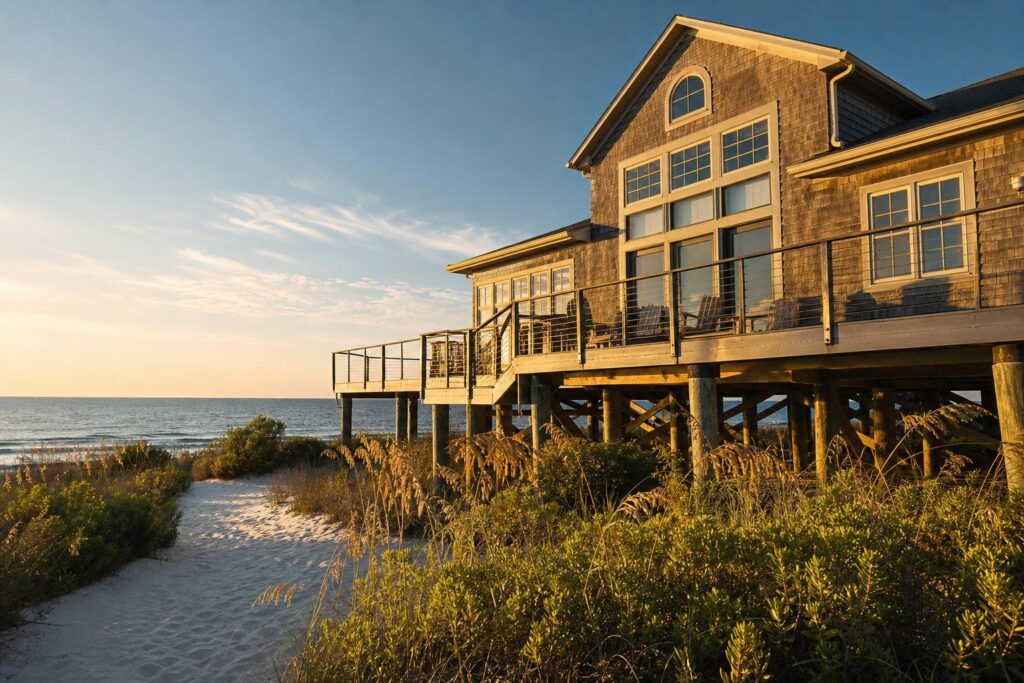
What are the windstorm and flood insurance costs for a vacation rental property on St George Island in 2026, and how do they affect your ability to get financing?
You should budget $16,000 to $35,000 per year in combined windstorm and flood insurance for a St George Island vacation rental, and those costs directly reduce your cash flow ratios that lenders use to approve your loan.
Why This Matters Right Now for St George Island Investors
I grew up on this island. My family moved here in 1968, and my father was a realtor on this coast, so I have watched the insurance landscape shift from a minor line item to the single biggest variable in a vacation rental investment. In 2026, insurance is no longer something you figure out after you close. It is something that determines whether you close at all.
Franklin County, where St George Island sits, carries the highest average flood insurance premiums of any county in Florida at $5,129 per year, according to FEMA data. That is nearly four times the statewide average of $1,363. When you stack windstorm coverage on top of that, a Gulf-front rental in the Gulf Beaches neighborhood or inside the Plantation gates can easily carry an annual insurance bill that rivals what some mainland buyers pay in total mortgage costs.
With over 300 transactions closed in my 13 years here, I can tell you that the investors who succeed on St George Island are the ones who build their insurance estimates into the deal from day one, not day thirty.
How Much Flood Insurance Actually Costs on St George Island
Let me be direct about the numbers because they catch a lot of first-time island investors off guard.
Almost every property on St George Island falls within FEMA Zone VE (coastal high-hazard with wave action) or Zone AE. That classification means flood insurance is mandatory if you are financing the purchase, no exceptions. And because this is a barrier island surrounded by the Gulf of Mexico on one side and Apalachicola Bay on the other, the risk ratings reflect that geography.
Here is what you are looking at for a typical St George Island vacation rental:
- NFIP flood policy (up to $250K building coverage): $5,000 to $12,000+ per year
- Non-primary residence surcharge: $250 per year (applies to all vacation rentals)
- Excess flood coverage (to bridge the gap above NFIP’s $250K cap): $2,000 to $5,000+ per year
That last bullet is critical. The average home price on St George Island is $1,502,000 with a median sale price of $1.2 million. The NFIP only covers up to $250,000 in building coverage. That leaves a gap of $750,000 to $1,250,000 that you either self-insure or cover with a private excess flood policy.
So what does that actually mean for your wallet? On a $1.5 million Gulf-front home in Gulf Beaches, near the Cape St. George Lighthouse along E. Gulf Beach Drive, you could be paying $8,000 to $17,000 per year in total flood-related insurance before you even address wind.
One investor I worked with last spring was evaluating a second-tier home just off W. Gorrie Drive. He had budgeted $3,000 for flood insurance based on a property he owned in the Florida Panhandle interior. When we ran the real numbers for the island, his annual flood cost came in at $6,800 with the NFIP surcharge and excess policy. That single line item changed his entire return projection and, ultimately, his offer price.
The Risk Rating 2.0 Factor for New Buyers
Here is something that surprises many investors: if you are purchasing a new property on St George Island in 2026, you pay the full Risk Rating 2.0 rate immediately. There is no phase-in. Existing policyholders benefit from an 18% annual cap on increases, but new buyers get no such cushion. This means the property’s current owner may be paying significantly less than what your premium will be on closing day.
Windstorm Insurance Costs on St George Island in 2026
Windstorm coverage is the other half of the equation, and on a barrier island, it is expensive by nature.
Most standard homeowners policies in Florida either exclude windstorm damage or carry a separate hurricane deductible. For St George Island properties, you are typically looking at:
- Annual windstorm/homeowners premium: $8,000 to $15,000+
- Hurricane deductible: 2% to 5% of dwelling coverage (percentage-based)
Let me put that deductible in real terms. On a $1.5 million home, a 2% hurricane deductible means $30,000 out of pocket before insurance pays a dime. At 5%, you are looking at $75,000. Florida law does protect you with a single-season deductible, meaning you only pay it once per hurricane season regardless of how many storms hit, but that first hit is substantial.
Citizens Property Insurance and Its Flood Requirement
If you end up with Citizens Property Insurance, Florida’s insurer of last resort, there is an additional wrinkle. As of January 1, 2026, any Citizens policy with $400,000 or more in dwelling coverage requires you to carry flood insurance, even if you would not otherwise be required to. On St George Island, where virtually every property exceeds that threshold, this requirement is essentially universal.
The Total Insurance Bill and How It Affects Your St George Island Financing
When I sit down with investors considering St George Island real estate, I walk through the full insurance stack because lenders certainly will.
Here is a realistic annual insurance breakdown for a $1.5 million vacation rental:
- Windstorm/homeowners insurance: $8,000 to $15,000+
- Flood insurance (NFIP or private): $5,000 to $12,000+
- NFIP non-primary residence surcharge: $250
- Excess flood coverage: $2,000 to $5,000+
- Liability/umbrella coverage: $1,000 to $2,500
- Total estimated annual insurance: $16,250 to $34,750+
Now, how does that affect financing? If you are using a DSCR loan, which is common for vacation rental purchases, insurance costs reduce your net operating income directly. Lenders typically require a debt service coverage ratio of 1.0x to 1.25x, meaning your rental income must cover 100% to 125% of your total debt service and expenses.
Here is an example that reflects what I see regularly on the island. An investor puts 25% down on a $1.5 million property. The loan amount is $1,125,000. At roughly 7% interest, the annual mortgage payment is about $89,800. Add $25,000 in insurance, $8,100 in property taxes, and $20,000 to $25,000 for property management and maintenance. Total annual expenses land between $143,000 and $148,000.
The top-performing vacation rentals on St George Island generate $100,000 to $126,000 in gross rental income. You can see the problem. Many properties struggle to meet a 1.0x DSCR with conventional financing when insurance is fully loaded. That does not mean the deal is impossible, but it does mean you need to be strategic.
Strategies That Work for St George Island Investors
So how do you make the numbers pencil out? I have helped investors navigate this for over a decade, and here is what I tell my clients:
- Increase your down payment. Moving from 25% to 35% or 40% down reduces your annual debt service enough to potentially clear the DSCR threshold.
- Explore private flood insurance. The Florida legislature passed SB 408 to encourage private flood competition. Private carriers can sometimes offer lower rates or higher coverage limits than the NFIP.
- Focus on properties with strong rental histories. A home in Gulf Beaches generating $126,000 in gross income tells a very different financing story than a bayfront cottage bringing in $65,000.
- Negotiate the purchase price around true carrying costs. In the current market, the average St George Island home sells for about 6% below list price with 121 days on market. There is room to negotiate.
One couple I worked with was eyeing a Plantation home priced at $1.7 million. After we mapped out the full insurance burden, they adjusted their search to a well-positioned second-tier Gulf Beaches home at $1.1 million. The lower price point reduced every insurance line item, kept their DSCR above 1.15x, and the rental history on the property actually showed stronger occupancy rates because of its proximity to Blue Parrot, BJ’s Pizza, and the core island attractions that renters love.
Why St George Island Remains a Strong Investment Despite Insurance Costs
Here is the part that keeps investors coming back to this 22-mile barrier island, even with these costs: there are no hotels on St George Island. Every single visitor stays in a vacation rental. That structural advantage creates consistent demand that most coastal markets cannot match.
The median sale price is up 13.8% year-over-year, and the price per square foot has climbed 24.5%. Appreciation on St George Island has historically been resilient even through storm seasons, and the island’s deliberate lack of high-rise development and chain stores preserves the character that drives repeat bookings.
With 33 five-star reviews and a ranking in the top 6% of my brokerage’s agents nationwide, I have seen cycles come and go on this island. Insurance costs are real, they are significant, and they are not going away. But they are also manageable when you work with someone who understands both the numbers and the nuances of this specific market.
Frequently Asked Questions
Is flood insurance required to buy a vacation rental on St George Island?
Yes. Virtually every property on St George Island falls within FEMA Zones VE or AE, which are designated Special Flood Hazard Areas. Any federally backed mortgage requires flood insurance in these zones. Even if you buy with cash, your windstorm carrier may still require a flood policy, especially through Citizens Property Insurance, which mandates flood coverage for policies with $400,000 or more in dwelling coverage.
How much is flood insurance on St George Island in 2026?
Franklin County has the highest average flood insurance premium in Florida at $5,129 per year according to FEMA data. However, Gulf-front and Zone VE properties on St George Island can pay significantly more, with premiums ranging from $5,000 to $12,000 or higher depending on elevation, construction type, and the property’s replacement cost. New buyers pay the full Risk Rating 2.0 rate immediately.
What is the NFIP coverage limit, and why is it a problem on St George Island?
The National Flood Insurance Program caps building coverage at $250,000 and contents coverage at $100,000. With the average St George Island home priced at $1,502,000, the NFIP’s cap leaves a gap of over $1 million. To bridge that gap, you need an excess flood policy from a private carrier, which adds $2,000 to $5,000 or more annually.
What is a hurricane deductible, and how does it work on St George Island?
Florida insurers are required to offer hurricane deductibles of $500, 2%, 5%, and 10% of dwelling coverage. On a $1.5 million St George Island property, a 2% deductible equals $30,000 out of pocket, and a 5% deductible equals $75,000. Florida’s single-season deductible rule means you only pay once per hurricane season, regardless of how many storms make landfall.
Can I get private flood insurance instead of NFIP on St George Island?
Yes. Private flood insurers now compete alongside the NFIP in Florida and can sometimes offer lower premiums, higher coverage limits, replacement cost valuations, and additional living expense coverage that the NFIP does not provide. I recommend getting quotes from both NFIP and private carriers before closing.
How do insurance costs affect DSCR loan approval for St George Island properties?
Insurance costs reduce your net operating income, which directly lowers your debt service coverage ratio. With total annual insurance running $16,000 to $35,000 on a typical St George Island rental, many properties struggle to meet the 1.0x to 1.25x DSCR threshold unless you increase your down payment or target properties with strong established rental income.
What is the total annual insurance cost for a vacation rental on St George Island?
For a property valued at approximately $1.5 million, expect total annual insurance costs of $16,250 to $34,750 or more. This includes windstorm/homeowners coverage, flood insurance, the NFIP non-primary residence surcharge, excess flood coverage, and liability or umbrella policies.
Does the NFIP charge more for vacation rental properties on St George Island?
Yes. The NFIP adds a $250 annual surcharge for non-primary residences. Since vacation rental investment properties do not qualify as primary residences, this surcharge applies to nearly every investor-owned property on the island.
What gross rental income do top St George Island vacation rentals generate?
Top-performing vacation rentals on St George Island are generating $100,000 to $126,000 in gross income in 2026. Properties with Gulf-front positions and proximity to the Gulf Beaches commercial district along W. Gorrie Drive tend to perform at the higher end due to walkability and renter demand.
Should I buy a St George Island rental property with cash to avoid insurance requirements?
Buying with cash eliminates the federally mandated flood insurance requirement, but it does not eliminate the risk. A single storm event could cause hundreds of thousands in uninsured damage. Most experienced investors I work with still carry full coverage even on cash purchases. The question is not whether to insure but how to structure coverage efficiently.
The Bottom Line
Insurance is the most important number in any St George Island vacation rental investment. With Franklin County carrying the highest flood premiums in Florida and windstorm coverage adding another $8,000 to $15,000 annually, your total insurance burden directly determines whether your deal pencils and whether your lender approves it. The island’s structural advantage, no hotels and pure vacation rental demand, remains powerful. But you need someone who can walk you through the real numbers, not the generic ones. I have been on this island since 1968, closed over 300 transactions, and I would rather give you an honest answer today than watch you learn the hard way after closing. If you are considering St George Island real estate, whether in Gulf Beaches, the Plantation, or anywhere on the island, call me at 850-653-7893 or reach out through Melissa Chandler Real Estate at 140 W 1st Street on the island. Let me help you build an investment that works.